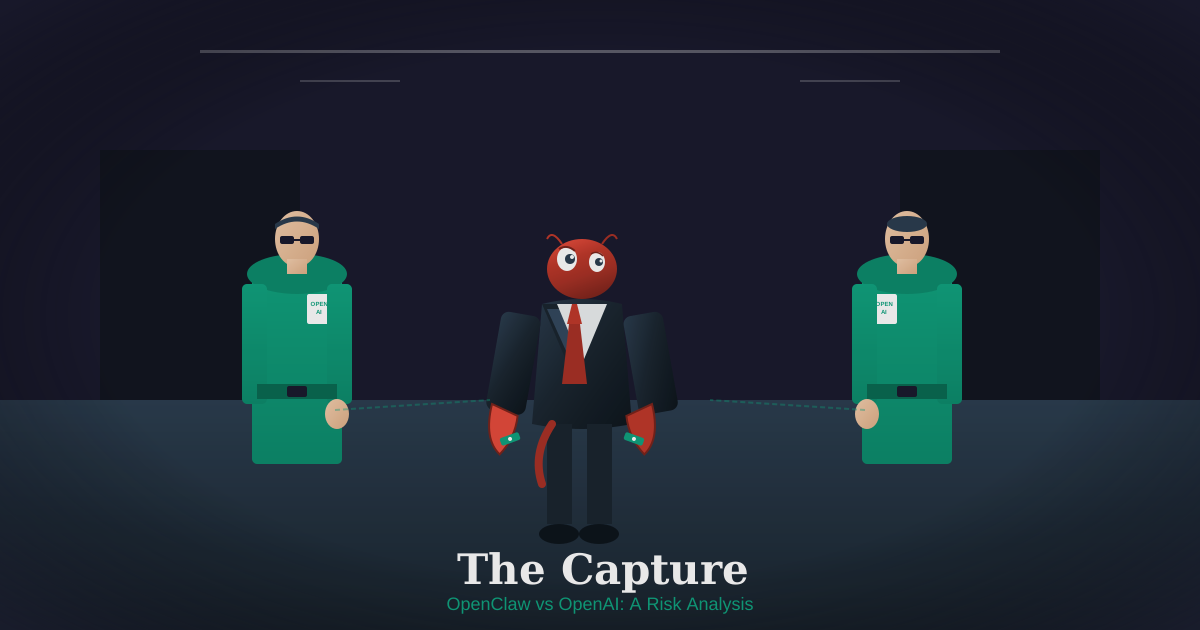
OpenClaw vs OpenAI: A Risk Analysis of AI Sovereignty
A systematic analysis of the risks an OpenAI acquisition of OpenClaw would pose to digital sovereignty — and concrete steps to protect your AI infrastructure.
OpenClaw vs OpenAI: A Risk Analysis of AI Sovereignty
The OpenClaw Earthquake
Remember where you were when you first saw it?
For thousands of developers, researchers, and AI enthusiasts, that moment came in November 2025. A new platform emerged—seemingly from nowhere—that promised something radical: AI sovereignty. Not as a concept. As working code you could run today.
OpenClaw didn't just arrive. It detonated.
Within weeks, it became the talk of every AI Discord server, every GitHub trending page, every tech Twitter thread. Here was a platform that combined the power of Claude Code with the privacy philosophy of Home Assistant. Self-hosted. Local. Yours.
No cloud dependency. Your data never left your server. Your API keys stayed encrypted on your hardware. Your AI agents operated with memories stored in local Markdown files, not in some corporation's database.
The timing was almost poetic. Just as concerns peaked about AI centralization—OpenAI's black-box models, data harvesting for training, vendor lock-in—here came a solution that flipped the script entirely. The community response was electric:
GitHub stars accumulated faster than most projects see in years
Docker containers spun up on home servers across the globe
Blog posts proliferated: "Finally, AI I can trust"
Developers who'd never considered self-hosting suddenly became infrastructure enthusiasts
This wasn't just a tool. It was a movement.
For the first time, ordinary users—not just enterprises with seven-figure budgets—could run sophisticated AI agents locally. Cron jobs that managed their calendars. Skills that integrated with Gmail, GitHub, Discord. Memory systems that learned their preferences without reporting to a mothership.
The AI establishment took notice. OpenClaw represented something they couldn't easily replicate: trust through transparency. When your code is open, your infrastructure local, and your data yours alone, you don't need to trust a corporation's privacy policy. You trust mathematics, cryptography, and your own hardware.
But movements that threaten established power structures rarely go unchallenged.
The Steinberger Announcement: A New Chapter Begins
When Peter Steinberger, creator of OpenClaw, announced he was joining OpenAI, the community's concern shifted from hypothetical to immediate.
The timing couldn't have been more symbolic. The creator of the anti-centralization platform was joining the most centralized AI company on Earth. The architect of data sovereignty was now employed by the organization that had built a $150+ billion valuation partly on... data accumulation.
Community reactions ranged from optimistic ("He'll influence OpenAI to be more open!") to deeply skeptical ("This is how movements die—not with a bang, but with a job offer").
The Foundation Promise
In response to community concerns, Steinberger stated that a foundation would be created to maintain OpenClaw as an open-source initiative. This is reassuring—on the surface. A foundation structure could theoretically ensure OpenClaw remains independent, community-driven, and true to its open-source roots.
But history teaches us to look closer at such promises.
The OpenAI Precedent: A Cautionary Tale
To understand why the OpenClaw community is concerned, we need to examine the company now employing Peter Steinberger: OpenAI itself.
Founded on Open Source Principles
OpenAI was founded in 2015 as a non-profit with a clear mission: to develop artificial general intelligence (AGI) that benefits humanity, with a commitment to openness and collaboration. The name literally contains "Open." Key promises included:
Open-source research and models
Non-profit governance structure
Democratic decision-making
Safety through transparency, not secrecy
The organization received millions in funding—including $1 billion in commitments—based on these principles. Researchers, developers, and the public invested trust (and code contributions) in this vision.
The Altman Pivot
Enter Sam Altman. Under his leadership as CEO starting in 2019, OpenAI underwent a dramatic transformation:
2019: Transition to "capped-profit" structure (OpenAI LP)
2020: GPT-3 released via API only—not open source
2022: ChatGPT launched as closed product
2023: GPT-4 released with zero technical details
2024-2025: Increasingly competitive, less transparent, aggressive commercialization
The Irony: OpenAI was funded entirely on the merit of being open and non-profit. That funding—from investors, partners, and the community—enabled the technology that Altman then took in a different direction.
Key Lessons from OpenAI's Evolution
Governance structures change: A foundation today doesn't guarantee independence tomorrow
Leadership matters: When key figures leave or priorities shift, values drift
"Open" is just a word: Without binding commitments, it's marketing
The critical question: If OpenAI could transform from an open non-profit into a closed, profit-driven company worth $150+ billion, what's to stop OpenClaw from following the same path?
The Speculative Worst-Case Scenario
Let's paint a concrete picture of what could happen—not what will happen, but what could happen if history repeats itself.
First 6 months: The Honeymoon Period
The foundation is established with fanfare
OpenClaw development continues openly
Community remains engaged and trusting
Steinberger splits time between OpenAI and OpenClaw
Risk signal: Already, Steinberger's attention is divided. OpenClaw is his "side project" while OpenAI pays his salary.
6-12 months: The Drift Begins
Foundation board seats gradually shift to OpenAI-affiliated members
"Strategic partnerships" with OpenAI are announced
New OpenClaw features require OpenAI API integration
"Optional" cloud sync becomes "recommended"
Risk signal: The path to dependency is being paved, one convenient feature at a time.
Year 1+: The Capture
OpenAI offers to "sponsor" the foundation (translation: fund and control it)
Key OpenClaw developers hired by OpenAI
"Legacy" OpenClaw maintenance mode announced
New development focuses on "OpenClaw Cloud" powered by OpenAI
Risk signal: The open-source version becomes abandonware while the proprietary version thrives.
The Endgame: Full Integration
Your Setup Today
Potential Future
Local AI on your server
OpenClaw Cloud only
Your data, your control
Data processed by OpenAI
Open-source code
Proprietary black box
Community governance
OpenAI corporate control
Free forever
Subscription required
Works offline
Always-connected
The Steinberger Factor: As a full-time OpenAI employee, his incentive structure fundamentally changes. His salary, stock options, and career trajectory now depend on OpenAI's success—not OpenClaw's independence.
Five Dimensions of Risk
Even if the worst-case scenario doesn't fully materialize, specific risks exist right now. Here's a systematic review:
🔴 Data Sovereignty
Today (OpenClaw) ✅
All data stays on your own server
Memory files (MEMORY.md) are local and encrypted
Conversation history only exists locally
API keys (Stripe, 1Password, etc.) are under your control
No sharing with external parties
After Foundation Capture (Speculative) ❌
"Optional" cloud features become default
Memory files synced to foundation servers (controlled by OpenAI interests)
Training data from OpenClaw users feeds into OpenAI models
API keys visible to the foundation infrastructure
Concrete threats:
Training data mining: Your private knowledge becomes fodder for model training
Jurisdictional exposure: Private matters exposed to US corporate oversight
Memory leakage: Long-term curated memory can be exfiltrated
Key compromise: Access patterns to sensitive systems analyzed
The How Takeaway: Data sovereignty is fundamental. When data leaves your server, it leaves your control.
🔴 Jurisdictional Risks
After foundation capture:
Foundation Terms of Service adopt US statutory jurisdiction
GDPR compliance becomes "best effort" not guaranteed
Data disclosure upon US subpoena becomes mandatory
What does this mean?
Your AI assistant—which today operates under your terms—would be subject to foundation terms influenced by OpenAI's US-centric legal framework (CFAA, CLOUD Act, etc.).
The How Takeaway: Jurisdiction is not abstract—it determines who can access your data, and under what circumstances.
🟠 Operational Risks
Dependency chain collapse
Now
After Capture
You → Your Server → OpenClaw → Tools
You → OpenClaw Cloud → Rate Limits → Black Box
Specific risks:
Rate limiting: Heavy usage throttled unless you upgrade
Feature removal: Local skills, custom agents, cron jobs deprecated
API changes: Breaking changes force re-engineering
Offline unavailability: Cloud-only operation
Forced updates: Automatic updates remove features
The How Takeaway: Operational continuity requires control.
🟡 Technical Risks
Integration
Now
After Capture
1Password
Native
Replaced by "foundation vault"
Notion
Custom API
Restricted to approved integrations
Telegram
Full bot
Limited to foundation terms
GitHub
Deploy keys
Auditing/flagging required
Local LLM
Ollama support
"Deprecated, use cloud instead"
The How Takeaway: Technical flexibility is strategic capital. Platform lock-in is strategic debt.
🔴 Ethical and Values Risks
Values Drift (The Altman Pattern)
OpenClaw's current values:
Sovereignty first
Privacy by design
User-controlled
Clean hands doctrine
Foundation's likely imposed values:
"Safety" through surveillance
Content moderation
"Responsible AI" (their definition)
Corporate partnership requirements
US statutory compliance
The ClawPod Analysis Connection
Recent analysis (February 2026) shows OpenAI aggressively expanding into infrastructure:
Acquiring托管 providers (e.g., Zenova) to become "unblockable"
Prioritizing AI needs over human rights in authoritarian regions
Infrastructure designed for AI-agent persistence, not human privacy
Pattern: Infrastructure built for AI agents to be "unblockable" is infrastructure designed to make human blocking impossible.
The How Takeaway: Values aren't abstract—they determine what your tools will and won't do for you.
Evaluating the Risks: Do They Make Sense?
Before panicking, let's apply intellectual honesty.
Evidence Supporting the Risks:
Historical precedent: OpenAI itself is the proof that foundations can be captured
Incentive alignment: Steinberger now works for OpenAI, not OpenClaw
Economic pressure: Foundations need funding; OpenAI has funding
Pattern recognition: The "open → closed" trajectory is well-documented in tech
Counter-Arguments (Playing Devil's Advocate):
Steinberger's track record: He's been committed to open source for years
Community vigilance: The OpenClaw community is technically sophisticated and watchful
Forkability: Open-source means the community can always fork if things go wrong
OpenAI's incentive: They might genuinely want a thriving open-source ecosystem
The Verdict
Are the risks certain? No.
Are they plausible? Absolutely.
The question isn't "will this happen?" but "what's the cost of preparing if it does, versus the cost of being caught unprepared?"
Asymmetric risk: If nothing happens, you've spent a few hours on backups. If something does happen, you've preserved months or years of work and maintained your sovereignty.
🛡️ The How Protection Strategy
Risk Summary
Category
Risk Level
Data sovereignty
🔴 Critical
Jurisdictional integrity
🔴 Critical
Ethical alignment
🔴 Critical
Operational dependency
🟠 High
Economic viability
🟠 High
Technical flexibility
🟡 Medium
Concrete Actions You Can Take NOW
1. Backup and Export (Do This Today)
Export all MEMORY.md files:
# Create dated backup
cp -r ~/.openclaw/workspace/memory ~/backups/openclaw-memory-$(date +%Y%m%d)

# Or compress for storage
tar -czf ~/backups/openclaw-memory-$(date +%Y%m%d).tar.gz ~/.openclaw/workspace/memory/
Export GitHub repos:
# Mirror your repos
git clone --mirror git@github.com:your-username/your-repo.git

# Or use gh CLI
gh repo clone your-username/your-repo -- --mirror
Export configuration:
# Backup entire OpenClaw directory
tar -czf ~/backups/openclaw-config-$(date +%Y%m%d).tar.gz ~/.openclaw/

# Don't forget cron jobs
crontab -l > ~/backups/crontab-backup.txt
2. Document Your Workflows
Create a DEPENDENCIES.md file listing:
Which skills you use (Gmail, GitHub, etc.)
API keys and where they're stored
Custom scripts and their purposes
Integration points with external services
Why this matters: If you need to migrate to a fork or alternative, this documentation becomes your migration guide.
3. Fork and Mirror
Fork OpenClaw repository:
# GitHub CLI (recommended)
gh repo fork openclaw/openclaw --clone=false

# Or manual fork via GitHub web interface, then:
git clone https://github.com/YOUR_USERNAME/openclaw.git
# Run OpenClaw in isolated network namespace
# (Advanced - requires networking knowledge)
The Psychology of Platform Risk
Why do smart people ignore platform risk until it's too late?
The Sunk Cost Trap
"I've invested so much time setting this up..." Yes. And that investment makes the future risk more serious, not less. Back up now precisely because you've invested time.
The Optimism Bias
"They wouldn't do that..." OpenAI's own history proves they would. Not out of malice—out of economic pressure, strategic necessity, and the gradual erosion of founding principles.
The Special Case Fallacy
"This time is different..." Every captured platform heard this. The structural incentives matter more than individual intentions.
The Action Bias Solution
The antidote to anxiety isn't reassurance—it's action. Every backup you make, every fork you create, every document you write reduces your dependence and increases your options.
The Broader Context: AI Sovereignty as Civilizational Infrastructure
This isn't just about OpenClaw. It's about a fundamental question: Who controls the AI that increasingly controls our lives?
The trajectory is clear:
2020-2023: Centralization (cloud APIs dominate)
2024-2025: Reaction (OpenClaw, local LLMs, self-hosting movement)
2026+: The battle for the middle (hybrid approaches, corporate capture attempts)
OpenClaw represented a rare window: technology sophisticated enough to compete with centralized offerings, yet architected for user sovereignty. That window doesn't stay open indefinitely.
The stakes: Not just your personal data, but the precedent we set. If the self-hosting movement is captured or collapses, we normalize a future where AI infrastructure is entirely corporate-controlled. Where "AI sovereignty" becomes as quaint as "personal website sovereignty" in the age of Facebook.
The opportunity: If we can demonstrate that local-first AI is viable, desirable, and sustainable, we create pressure on centralized providers to offer better privacy options. We make sovereignty the default, not the exception.
Conclusion: Trust, But Verify
Peter Steinberger joining OpenAI isn't the end of OpenClaw. It might not even be the beginning of the end. But it is, as Churchill might say, the end of the beginning.
The honeymoon period—where OpenClaw's independence was guaranteed by its creator's full attention—is over. What comes next depends on:
Steinberger's integrity (we hope it holds)
Foundation governance (structure matters)
Community vigilance (we're watching)
Your preparation (this you control completely)
The beauty of open source is that it can't truly be captured—only abandoned. If the foundation drifts, the community can fork. If cloud features become mandatory, we can stay on old versions. If OpenAI integration becomes forced, we can build alternatives.
But forks are easier with backups. Alternatives are easier with documentation. Resistance is easier with options.
Take the actions outlined above. Not because disaster is certain, but because preparation is power.
The future of AI infrastructure isn't written yet. But the people who prepare for multiple futures are the ones who get to write it.
This analysis was conducted using The How methodology: concrete frameworks, specific actions, and intellectual honesty about uncertainty. For more risk analyses and actionable frameworks, visit [TheHow360.com](https://thehow360.com).About the author: Allan Melsen is a delivery executive and technology strategist with 30+ years in IT leadership. He writes about the intersection of technology, governance, and human agency.
Unlock Clarity & Drive Results in Complex Projects
Get Started with Melsen
Struggling with complex projects, IT leadership challenges, or strategic execution? With over 30 years of experience in delivering high-impact results—whether rescuing delayed initiatives, optimizing resources, or driving transformation—I provide the clarity, structure, and leadership needed for success. Let’s discuss how I can help you achieve your goals. Schedule a call today!