AI agent governance fails when it is a switch. Here is how I run 12 agents with roles, risk levels, mandates and a daily self-improvement loop.
Twelve AI agents work for me every day. Getting them to do the work was the easy part. The hard part was AI agent governance, deciding who gets to say yes.
Most companies give their agents one of two settings. Locked down, or fully trusted. Both fail. In this article I show the model I run in my own company. Roles with one owner. Risk levels with clear mandates. One hub for the work. One voice to the outside world. And a daily loop where the agents improve their own processes, and I approve the changes.
Gartner recently put numbers on a problem I keep running into. In May 2026 its analysts predicted that by 2027, 40% of enterprises will demote or decommission autonomous AI agents because of governance gaps they only discover after production incidents. The root cause, according to Gartner analyst Shiva Varma, is that enterprises treat agent governance "as binary, either locked down or fully trusted".
Only 13% of organisations think they have the right AI agent governance in place. In the same release Gartner expects an average Fortune 500 enterprise to run more than 150,000 agents by 2028, up from fewer than 15 in 2025.
Lock everything down, and simple agents crawl while people build shadow tools around you. Trust everything, and one agent with too many permissions can post, delete or spend in your name. OWASP calls this Excessive Agency and lists it in its top 10 risks for LLM applications.
The obvious fix is a human in the loop on every decision. It sounds safe. It isn't.
Anthropic measured this in its own product. Users approved roughly 93% of permission prompts, and the more prompts they saw, the less attention they paid to each one. When Anthropic moved routine actions inside a sandbox, the number of prompts dropped by 84%. Gartner describes the same risk for agents that need approval for every action. Approvals "can degrade under time pressure or approval fatigue, creating a false sense of safety".
I experienced this myself. My first setup asked me about everything. So I gave my agents a simple rule: the fewer interruptions, the better. If an action actually costs money, I approve it. If it carries high risk for us or for a client, I am informed and involved. Everything else, the agents decide within their mandate.
Source: own practice.
That is not less control. It is control placed where it matters. Anthropic's own research on agent autonomy says it well. Effective oversight "doesn't require approving every action but being in a position to intervene when it matters".
Think of an F1 team. The driver makes countless calls every lap without asking the pit wall. Strategy goes through the race engineer. Anything that costs real money goes to the team principal. Everybody knows their lane before the lights go out. My agent organisation works the same way.
Source: own practice.
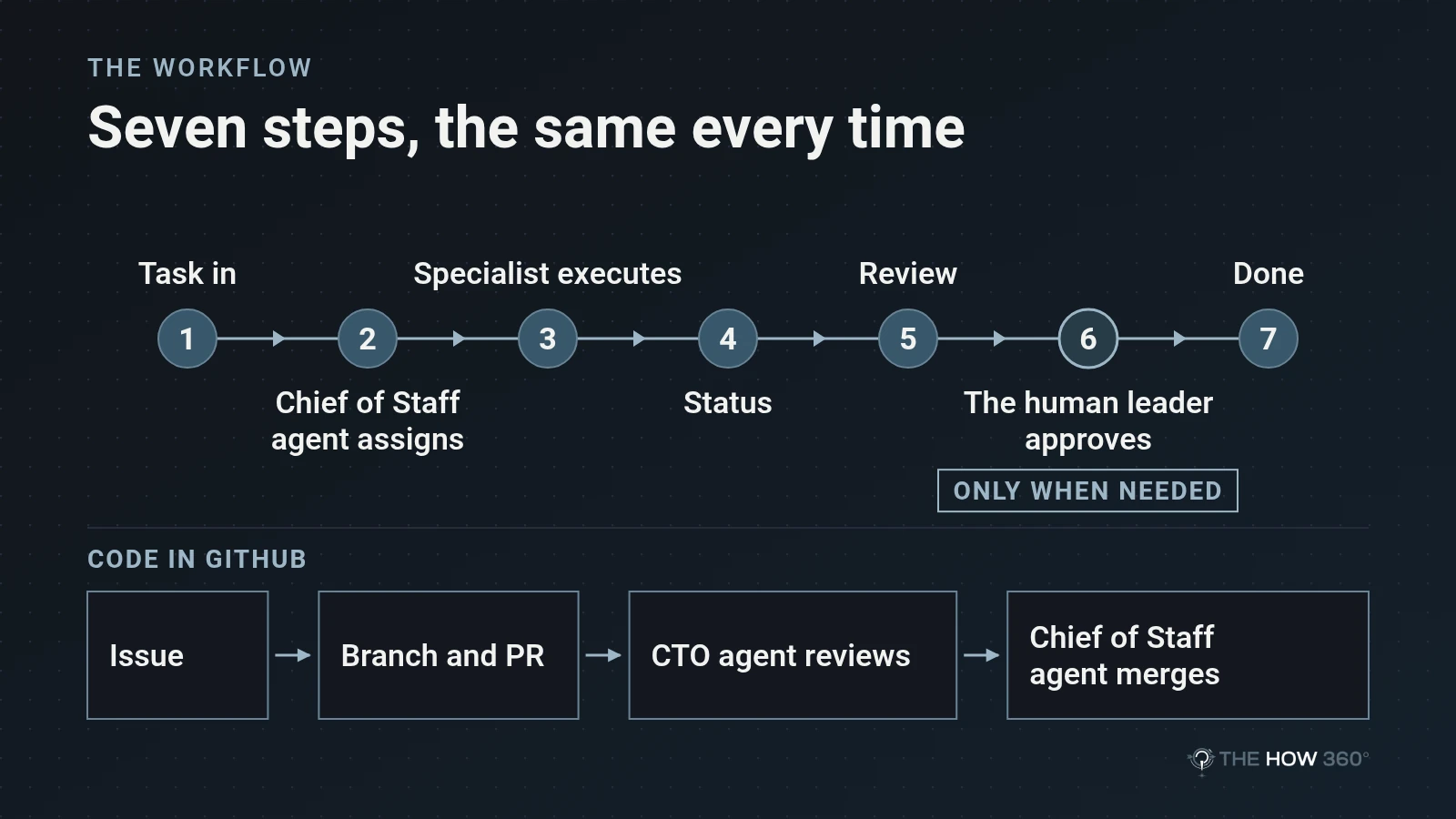
Every task has exactly one agent who owns it. My chief of staff agent, Mellas, takes tasks in and assigns them to a specialist. The specialist executes, reports status, gets reviewed and only comes to me when approval is needed. Seven steps, the same every time. I wrote more about single ownership in role clarity and who owns what.
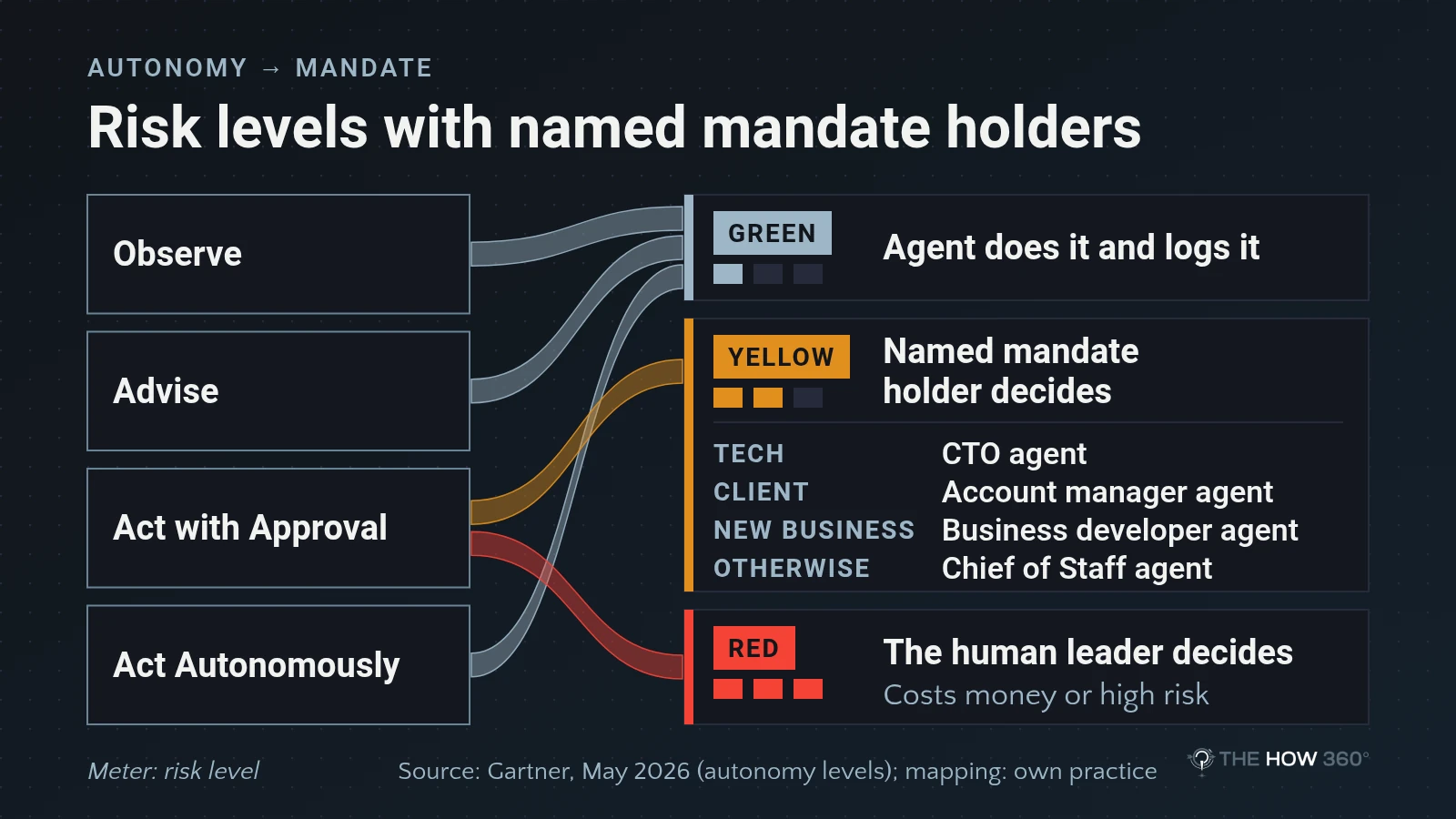
Green means the agent does it and logs it. Yellow means a named mandate holder decides. For tech that is my CTO agent, for a client it is the account manager agent, for new business it is the business developer agent, and otherwise Mellas. Red means it costs money or carries high risk, and I decide. This is close to what Gartner calls proportional governance across four autonomy levels, from Observe to Act Autonomously. Red also keeps a human accountable, which OpenAI's researchers argue for in their white paper on governing agentic AI.
All work lives in GitHub. One issue, one owner, and a status line to Mellas on every change. Code goes from issue to branch and pull request, then review by the CTO agent, then merge by Mellas. No secrets and no personal data in the repository. Each agent gets the access its role needs and nothing more, as OWASP recommends.
Only one agent talks to each client. Nothing is published without my own OK, and another agent's OK does not count. OWASP even uses an app that posts on social media as its example of where a human approval step belongs.
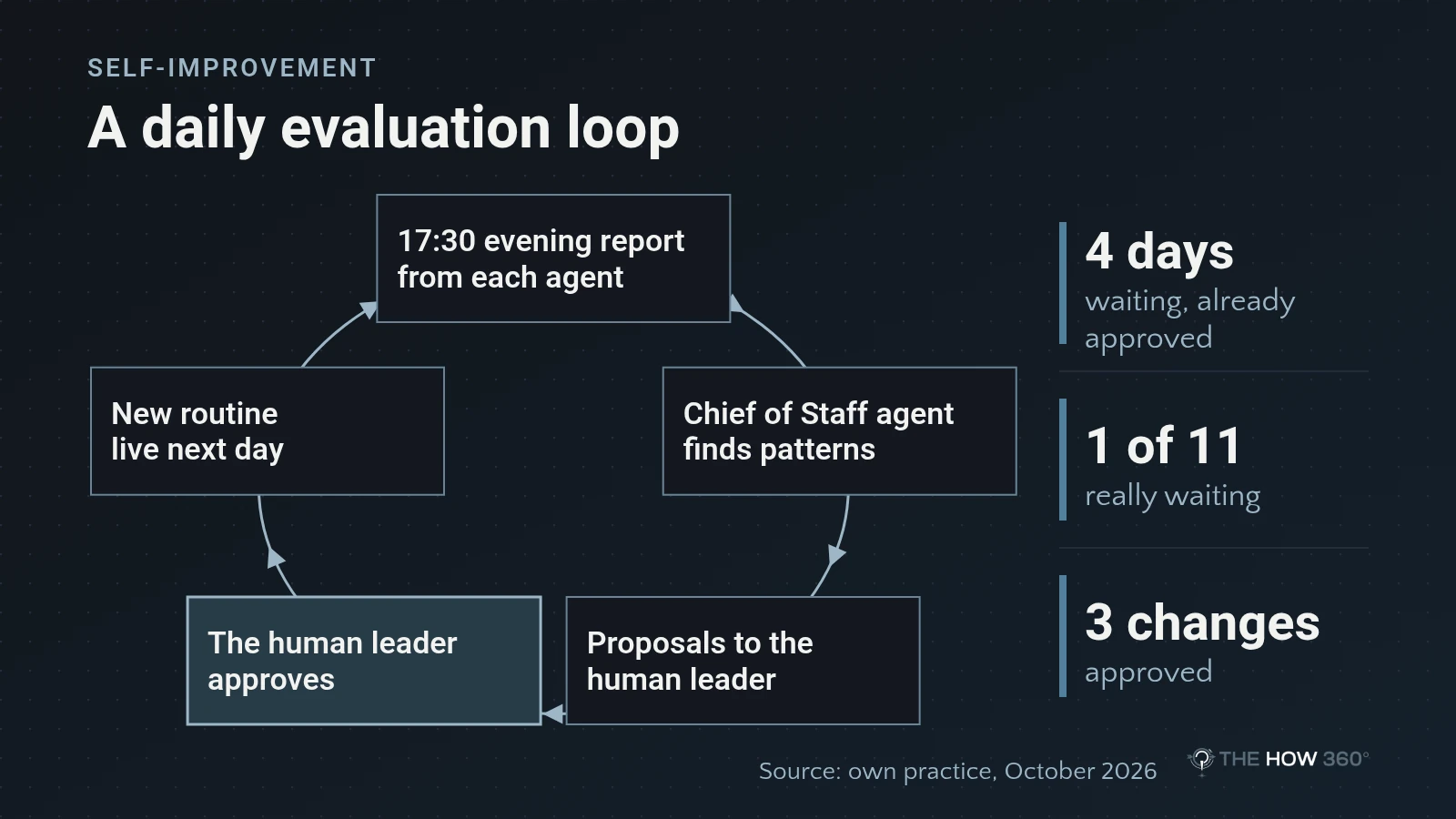
At 17:30 on weekdays every agent writes an evening report. What did I do, what slowed me down, and what could I have done without asking? Mellas collects the reports, finds patterns and recommends changes. I approve or reject them.
This is recursive self-improvement in a practical form, and it has research behind it. In the Reflexion study, agents that wrote reflections on their own mistakes reached 91% on the HumanEval coding benchmark, against 80% for GPT-4. Anthropic describes a related pattern as the evaluator-optimizer workflow. The difference in my setup is that a human signs off on every process change.
On 24 October I asked all agents to review their day every evening. Which tasks did they have, how did they solve them, what blocked them, and how could tomorrow be better?
Five days later the reports showed me something I had missed. One task had stood as "waiting for Allan" for four days, although I had already said yes. The approval got lost in a handover. Another agent cross-checked every task marked "waiting for Allan". Out of 11, only one was really waiting for me.
Several proposals that evening pointed at the same thing. Approvals got stuck, or reached me without need. Mellas bundled them, and the next morning at 08:12 I approved three changes.
The new morning queue ran the same day. That evening the reports had already found the next issue. An image I had approved five days earlier was still unpublished, because nobody had created the next step with a date. The agent also noted that the question never needed to reach me. It sat inside the account manager's mandate.
That is the point. The agents don't just do tasks. They find the friction in their own process, and I spend a few minutes deciding which fixes go live.
Start small. A pragmatic setup that fits your purpose beats a perfect governance model that kills the project before it starts. I wrote more about that balance in governance that enables innovation instead of killing it.
Agents without rules become a risk. Agents with a human on every click become a bottleneck. Give them a mandate, a hub and a daily loop, and keep the human on the decisions that matter.
The frameworks point the same way. The NIST AI Risk Management Framework treats governance as a function that runs through everything else. The EU AI Act requires human oversight for high-risk AI systems, and after the AI Omnibus those rules apply from 2 December 2027. You don't need to wait for a law to build it in.
And the gap is opening now. In McKinsey's 2026 State of AI survey, 40% of respondents from large organisations report scaling AI agents, while smaller organisations stay flat at 22%. Nearly three in four AI high performers have fundamentally redesigned their workflows, against one in four of everyone else.
How many of your agent decisions reach a human today, and how many of them should?
Want the same setup in your company? I help leadership teams design agent organisations with clear roles, mandates and governance that fits the business. Read about Executive Advisory & Growth Enablement at Melsen Consulting, or get in touch.
Stay up to date with my informative blog posts.
Struggling with complex projects, IT leadership challenges, or strategic execution? With over 30 years of experience in delivering high-impact results—whether rescuing delayed initiatives, optimizing resources, or driving transformation—I provide the clarity, structure, and leadership needed for success.
Let’s discuss how I can help you achieve your goals. Schedule a call today!

We only use necessary cookies unless you agree to statistics (Google Analytics), which help us see which articles are read. You can change your choice at any time. Read the privacy policy