Why Your Organization Needs a PMO (and What Kind)

A practical framework for diagnosing whether your organization needs a PMO, which type fits your context, and how to start without creating bureaucracy.

Someone eventually says it.

Projects are late. Status reports do not match reality. Priorities change every week. Teams are overloaded, but leadership still cannot see where the real constraints are. Every department has its own spreadsheet, timeline, and explanation for why things are stuck.

Then the sentence lands in the room:

“We need a PMO.”

Maybe you do.

But that sentence often means something more specific. It can mean “we cannot see the work.” It can mean “we cannot agree what matters.” It can mean “teams keep waiting on each other.” It can mean “decisions are too slow.” Or it can mean “we have no delivery rhythm and everyone is improvising.”

Those are different problems. They should not all get the same solution.

A PMO should not be a department you create because execution feels messy. It should be an operating mechanism you design to remove a specific kind of friction. The lighter the mechanism that solves the real problem, the better.

So do not start with: “What should our PMO look like?”

Start with: “What pain are we actually trying to remove?”

A PMO is useful when it solves an operating problem

The bad version of a PMO is familiar.

It asks for updates. It creates templates. It runs meetings. It produces dashboards that look clean but do not change the work. Leaders get more reporting, teams get more admin, and delivery does not improve.

That version deserves its reputation.

The useful version is different. A good PMO makes execution easier. It gives leadership a shared view of the portfolio. It helps teams see dependencies earlier. It creates a practical rhythm for decisions, risks, priorities, and follow-through. It clarifies who owns what without turning every project into a compliance exercise.

The difference is not the name. It is the mandate.

If your PMO only asks for updates, you built a reporting office, not an execution mechanism.

If the PMO exists to collect information, it will become a reporting office. If it exists to improve execution, it has a chance.

Five problems a PMO can solve

Before choosing a PMO model, diagnose the execution problem. Most organizations are dealing with one or more of these.

Use the five-pain map as a diagnosis tool before deciding what kind of PMO to build.

1. Visibility problem

Leadership cannot see what is actually happening.

The portfolio exists, but only in fragments. Project A looks green because the team is reporting effort, not outcomes. Project B is stuck behind a dependency nobody has escalated. Project C is still active even though its business case quietly died three months ago.

You do not have one version of the truth. You have status theatre.

A visibility problem sounds like:

  • “What is actually going on?”
  • “Why are we only hearing about this now?”
  • “Which projects are at risk?”
  • “How much work have we committed to?”
  • “What should we stop?”

If this is the main pain, the first PMO job is not governance. It is clarity.

2. Prioritization problem

Everything is important, which means nothing is.

Teams are asked to deliver strategic initiatives, operational improvements, customer commitments, internal fixes, leadership requests, and “quick” side projects at the same time. Nobody wants to say no, so the organization says yes to everything and then pays for it through slow delivery.

A prioritization problem sounds like:

  • “Why is the team overloaded again?”
  • “Who approved all this work?”
  • “Which initiatives matter most this quarter?”
  • “Why are strategic projects competing with noise?”
  • “What do we pause when new work comes in?”

If this is the main pain, the PMO needs to help create a prioritization rhythm. Not a huge scoring model. A rhythm. A way to compare work, make trade-offs, and keep capacity visible.

3. Coordination problem

Teams depend on each other, but the handoffs are unclear.

Sales needs Delivery. Delivery needs Product. Product needs Legal. Legal needs input from someone who is in back-to-back meetings for the next two weeks. Every team is doing its part, but the system keeps stalling between teams.

A coordination problem sounds like:

  • “We were waiting for them.”
  • “Nobody told us the date moved.”
  • “That decision affects our plan.”
  • “We keep discovering dependencies too late.”
  • “The work is not hard, but the handoffs are painful.”

If this is the main pain, the PMO should focus on dependencies, sequencing, and decision points. The goal is flow, not control.

4. Delivery discipline problem

Plans exist, but follow-through is inconsistent.

Teams start with energy. The kick-off is good. The slide deck is convincing. Then the cadence fades. Owners become vague. Risks are mentioned but not managed. Milestones drift. Nobody is quite sure whether the plan changed or simply got forgotten.

A delivery discipline problem sounds like:

  • “We start well, but we do not finish well.”
  • “Owners are unclear after the first few weeks.”
  • “Risks are tracked, but not acted on.”
  • “Every project has a different way of working.”
  • “We keep re-planning instead of delivering.”

If this is the main pain, the PMO should help with delivery rhythm, planning quality, ownership, and follow-through. It should raise the standard of execution without taking delivery ownership away from the teams.

5. Governance problem

Decisions are slow, inconsistent, or made in the wrong place.

Some decisions are escalated too high. Others are made too low without the right context. Approvals happen in side conversations. Risk tolerance is unclear. The organization does not know which decisions need governance and which simply need a responsible owner.

A governance problem sounds like:

  • “Who is allowed to decide this?”
  • “Why is this waiting for steering committee?”
  • “Why did two teams make different calls on the same issue?”
  • “When do we escalate?”
  • “What is the actual approval path?”

If this is the main pain, the PMO can clarify decision rights, escalation routes, risk handling, and standards. But it has to be careful. Governance should speed up good decisions, not slow down every decision.

A quick example

Imagine a 300-person technology company with three strategic initiatives running at the same time:

  • A new customer portal
  • A pricing-model change
  • A data-platform upgrade

Each initiative looks manageable in isolation. The problem is the overlap. The same product managers are needed in all three. Legal review is late on the pricing work. The data-platform upgrade changes assumptions for the portal. Sales has already promised launch dates that Delivery has not committed to.

On paper, the company has a project problem. In reality, it has a coordination and prioritization problem.

A heavy governance PMO would make this worse if it arrived with templates, approval gates, and a demand for weekly status reports. The first useful move would be much smaller: one shared portfolio view, one dependency review, and one leadership trade-off forum where capacity conflicts are made visible before they become delivery failures.

That is the point. The right PMO model depends on the friction.

Four practical PMO types

There are many textbook PMO categories. Most leaders do not need them at the start.

In practice, these four shapes cover most needs.

Visibility PMO

A Visibility PMO creates one shared view of work across the portfolio.

It is useful when leaders cannot see what is happening, what is at risk, what is consuming capacity, or which initiatives deserve attention. It makes the portfolio visible enough to discuss honestly.

What it does:

  • Builds a simple portfolio view
  • Standardizes the minimum useful status information
  • Shows risks, dependencies, milestones, and capacity pressure
  • Helps leadership spot conflicts and overload

Watch out for becoming a dashboard factory. The dashboard is not the product. Better decisions are the product.

Coordination PMO

A Coordination PMO helps work move across teams.

It is useful when delivery stalls at handoffs, dependencies are discovered too late, or teams are working from different timelines. It does not need to own the work. It needs to make the connections visible and keep the system moving.

What it does:

  • Maps cross-team dependencies
  • Helps sequence work across functions
  • Runs dependency and risk reviews
  • Escalates blockers before they become surprises
  • Clarifies who needs to make which decision by when

Watch out for becoming a meeting coordinator with no authority. Coordination requires enough mandate to challenge teams and escalate real blockers.

Governance PMO

A Governance PMO clarifies how decisions, risks, approvals, and standards work.

It is useful when decision paths are unclear, project quality varies widely, or risk handling depends too much on personal relationships. Done well, it creates a cleaner operating model.

What it does:

  • Defines decision rights and escalation paths
  • Sets lightweight standards for business cases, plans, risks, and changes
  • Supports steering forums with useful information
  • Makes approval routes explicit
  • Helps leaders separate decisions that need governance from decisions that need ownership

Watch out for becoming a gatekeeper. Governance should remove ambiguity. It should not turn normal execution into paperwork.

Delivery Enablement PMO

A Delivery Enablement PMO improves how teams plan, execute, and follow through.

It is useful when teams need better delivery habits, but the organization does not want to centralize ownership of every project. This PMO acts more like a coach, challenger, and operating support function.

What it does:

  • Improves planning quality
  • Helps define outcomes, milestones, owners, and risks
  • Supports delivery cadences
  • Coaches project leads and initiative owners
  • Shares practical methods without forcing a heavy methodology

Watch out for taking ownership away from the teams. The PMO can support delivery. It should not become the place where accountability goes to hide.

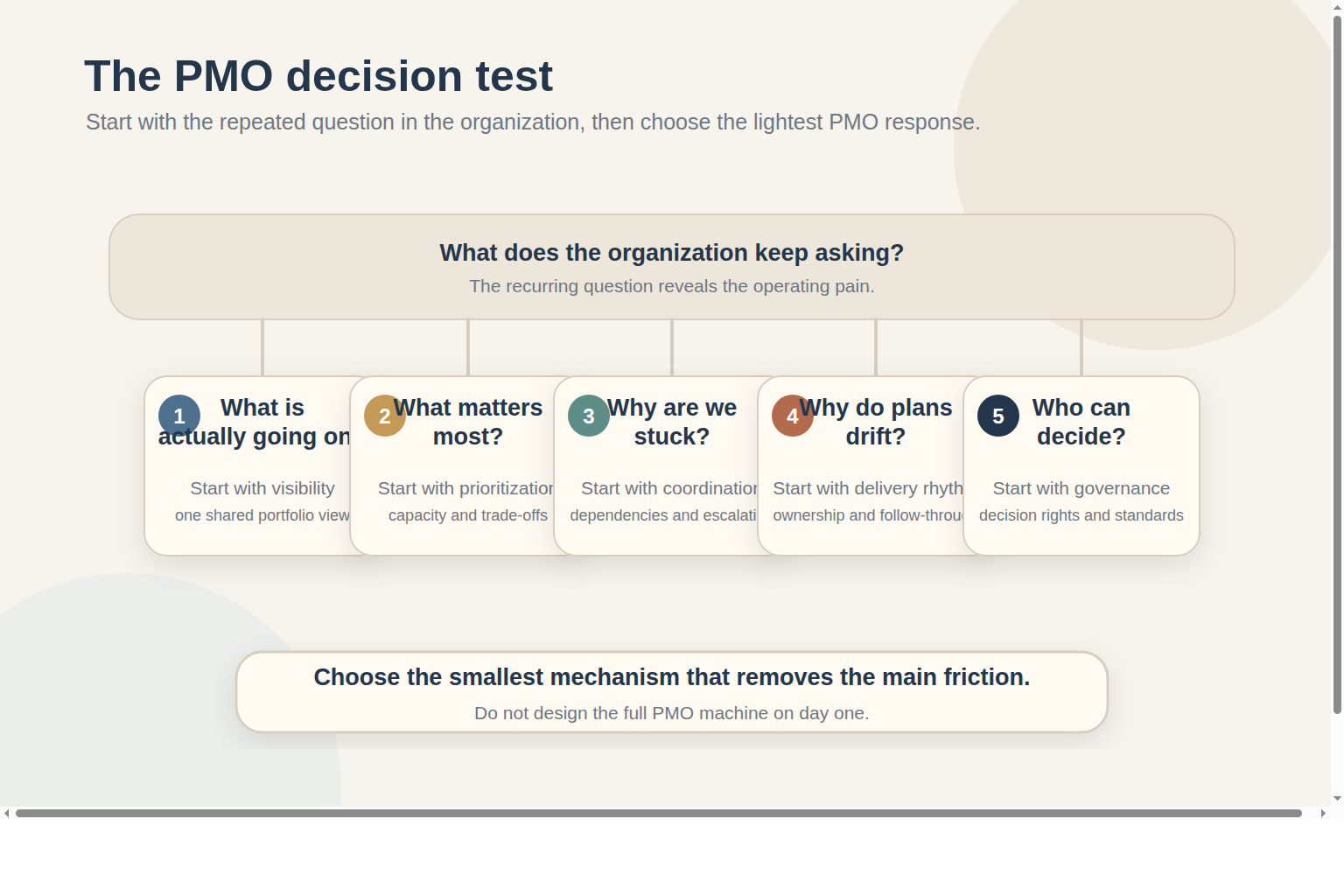
The decision test: what pain are you trying to remove?

Use this as the first conversation.

If leaders keep asking, “What is actually going on?” start with a Visibility PMO.

If teams keep asking, “What matters most?” start with prioritization. This may sit inside a Visibility PMO at first, but the real work is trade-offs.

If work stalls between teams, start with a Coordination PMO.

If plans repeatedly collapse after kick-off, start with a Delivery Enablement PMO.

If decisions are slow, unclear, or inconsistent, start with a Governance PMO.

You may eventually need more than one shape. That is fine. But do not design the full machine on day one.

Choose the lightest structure that removes the main friction.

A weekly portfolio review may solve more than a new department. A shared dependency map may solve more than a methodology rollout. Clear decision rights may solve more than another steering committee.

The right PMO is not the biggest PMO. It is the one that fits the pain.

What a PMO should not become

A PMO can become useful quickly. It can also become expensive theatre.

Here are the warning signs.

A reporting office that changes nothing

If teams spend hours feeding the PMO and leaders still do not make better decisions, the PMO is extracting information without creating value.

Status reporting is only useful if it changes prioritization, risk response, escalation, or support.

A compliance layer

Templates can help. Standards can help. But process is not the point.

If the PMO slows down delivery in the name of control, people will work around it. And they will often be right to do so.

A substitute for leadership prioritization

A PMO can facilitate prioritization. It cannot replace leadership choices.

If executives refuse to make trade-offs, the PMO will end up documenting overload instead of solving it.

A place where delivery ownership disappears

The PMO should not become the owner of every difficult initiative.

Delivery owners still need to own delivery. Sponsors still need to sponsor. Teams still need accountability. The PMO can make that easier, but it cannot carry the whole organization on its back.

A template factory

When process becomes the product, the PMO has lost the plot.

If the PMO creates more work than it removes, it has misunderstood its job.

The minimum viable PMO

You do not need a large PMO to start. You need a clear mandate and a few useful mechanisms.
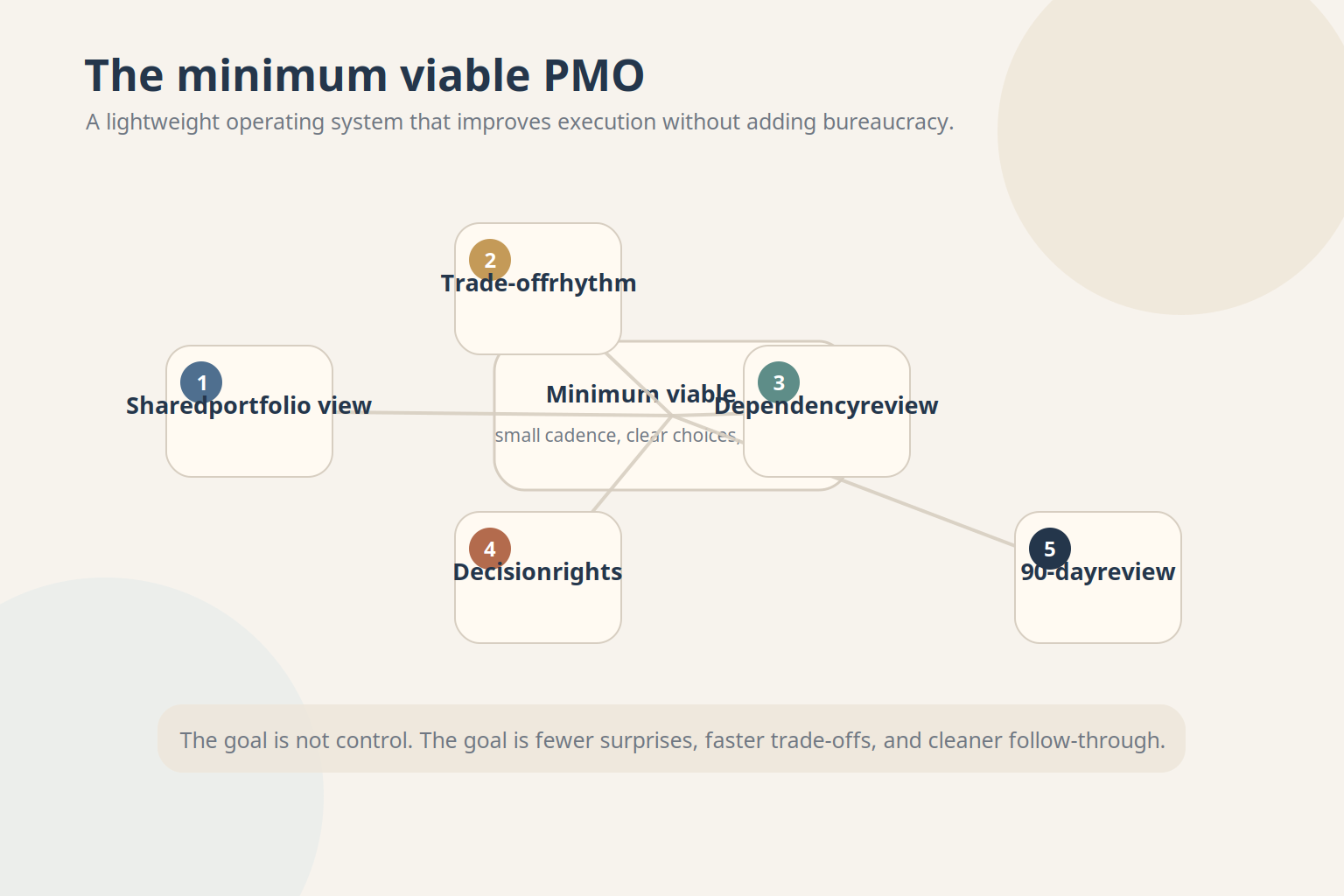
A minimum viable PMO can be as simple as this:

  1. A mandate tied to one or two execution pains
  2. A shared portfolio view
  3. A simple prioritization rhythm
  4. A dependency and risk review cadence
  5. Clear decision rights and escalation paths
  6. Lightweight standards for planning and status
  7. A 90-day review of whether friction actually decreased

A minimum viable PMO is an operating system, not a bureaucracy: visible work, clean trade-offs, dependency review, decision rights, and a 90-day feedback loop.

That last point matters.

Do not measure the PMO by how many reports it creates, how many meetings it runs, or how many templates people use. Measure whether the original pain has gone down.

Can leaders see the work earlier? Are teams less overloaded? Are dependencies surfaced sooner? Are decisions faster? Are risks acted on? Are plans more realistic? Is delivery easier?

If yes, the PMO is earning its place.

If no, simplify or redesign it.

The How: A 30-minute PMO fit check

Before you create a PMO, run this exercise with a small group of leaders and delivery owners.

Step 1: List the top execution pains

Write down the ten frustrations people mention most often. Use real language, not management language.

Examples:

  • “We find out too late.”
  • “Everything is priority one.”
  • “Nobody knows who decides.”
  • “Teams are waiting on each other.”
  • “Status is always green until it is suddenly red.”

Step 2: Group the pains

Put each pain under one of these categories:

  • Visibility
  • Prioritization
  • Coordination
  • Delivery discipline
  • Governance

Do not overthink it. The pattern will show up quickly.

Step 3: Pick the top two categories

Choose the two categories with the highest business impact. Not the categories that annoy people most. The ones causing missed outcomes, wasted capacity, slow decisions, or strategic drift.

Step 4: Choose one lightweight mechanism for each

Keep it small.

  • Visibility: one shared portfolio view
  • Prioritization: a monthly trade-off forum
  • Coordination: a dependency review
  • Delivery discipline: a standard milestone and owner rhythm
  • Governance: a decision rights map

Do not launch a full PMO model yet. Install the smallest mechanism that tests whether you are solving the right pain.

Step 5: Define what the PMO will not own

This is where many PMOs go wrong.

Be explicit:

  • The PMO will not own business decisions.
  • The PMO will not own every project outcome.
  • The PMO will not create process for its own sake.
  • The PMO will not replace sponsor accountability.

Boundaries protect the PMO from becoming the dumping ground for every unresolved leadership problem.

Step 6: Review after 90 days

Ask one blunt question:

Did friction decrease, or did reporting increase?

If friction decreased, build carefully from there.

If reporting increased but the pain stayed the same, stop and redesign.

Start with the pain, not the org chart

A PMO earns its place when it makes execution easier.

That is the test.

Not whether it has a polished charter. Not whether the templates look professional. Not whether the portfolio dashboard has perfect colors.

Does it help leaders make trade-offs? Does it help teams coordinate? Does it surface risk early? Does it speed up decisions? Does it make ownership clearer? Does it remove friction from delivery?

If the answer is yes, you are building operating leverage.

If the answer is no, you are building another layer.

Before creating a PMO, name the operating problem. Then design the lightest PMO model that removes that friction.

Start with the pain, not the org chart.

News & Articles

Discover the Latest Blogs

Stay up to date with our informative blog posts.

Unlock Clarity & Drive Results in Complex Projects

Get Started with Melsen

Struggling with complex projects, IT leadership challenges, or strategic execution? With over 30 years of experience in delivering high-impact results—whether rescuing delayed initiatives, optimizing resources, or driving transformation—I provide the clarity, structure, and leadership needed for success.
Let’s discuss how I can help you achieve your goals. Schedule a call today!