

A practical framework for bridging the gap between sales commitments and delivery execution, including handoff-hygiene checklists and role-clarity mapping.
You know the story. I've sat in both chairs—the sales lead celebrating the win, and the delivery lead staring at the impossible backlog. The sales team celebrates a big win—a new client, a multi-year contract, a signature on the dotted line. Champagne corks pop. High‑fives all around.
Then, the handoff happens.
The delivery team opens the project folder and stares at a 300‑page RFP, a 50‑slide deck, and a spreadsheet with 127 “requirements” that conflict with each other. The salesperson has moved on to the next deal. The client expects delivery yesterday. And the delivery lead is left holding a bag of promises that no one knows how to unpack.
This isn’t a failure of sales or delivery. It’s a translation failure.
We treat the handoff from sales to delivery as a paperwork exercise. But it’s actually a design problem. When sales commitments aren’t translated into executable backlogs, you get:
The gap between the promise and the delivery is where most projects go to die. And the reason is simple: we skip the translation layer.
The translation layer is the deliberate process that turns sales commitments into executable backlogs. It’s not a meeting. It’s not an email. It’s a designed step that ensures what was sold can be built, and what gets built matches what was sold.

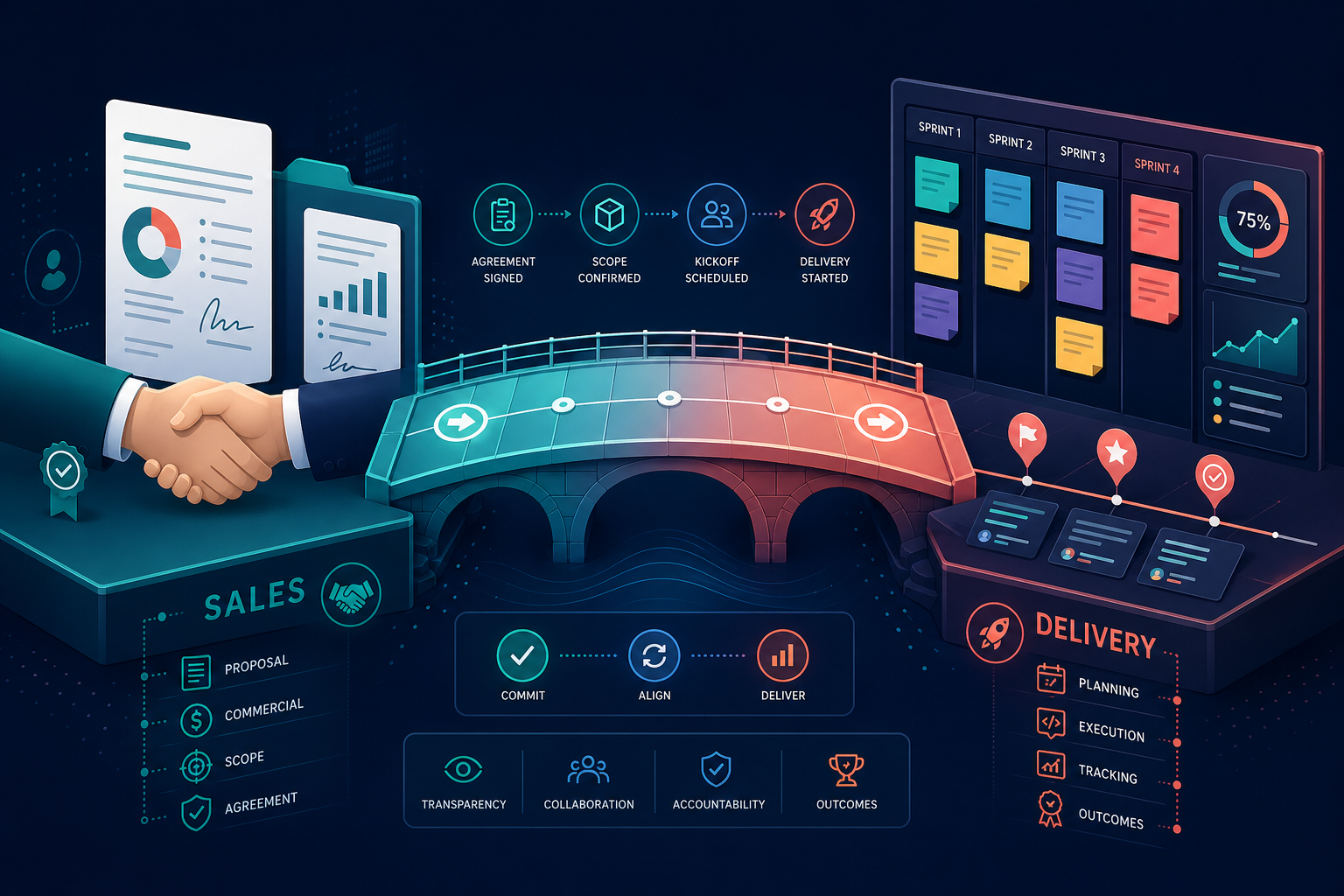
Think of it as the architectural blueprint that sits between the sales pitch and the developer’s keyboard. Without it, you’re asking a construction crew to build a skyscraper from a cocktail‑napkin sketch.
In my work with service‑based companies, I’ve seen this gap swallow millions in margin and burn through team morale. The fix isn’t more process; it’s better translation.

A translation layer is built from three pieces:
Let’s walk through each.
Before any handoff, sales and delivery must sit together and map the explicit commitments from the deal. Not the slides. Not the “vibe.” The concrete, written‑down promises.
I use a simple one‑page canvas:
| Commitment | Source (slide/page) | Assumptions | Constraints |
|---|---|---|---|
| e.g., “24/7 support” | Slide 45 | Client will provide monitoring API | Must use existing support platform |
| e.g., “AI‑driven recommendations” | RFP section 3.2 | Client data is clean and accessible | Cannot use external LLM APIs |
This isn’t about blame. It’s about clarity. When you put every commitment on one page, you quickly see which ones are vague, which ones conflict, and which ones are missing critical assumptions.
Rule of thumb: If a commitment can’t be expressed as a testable outcome, it’s not ready for the backlog.
The handoff is the most fragile moment in the project lifecycle. A clean handoff reduces rework by 40–60% in the teams I’ve worked with. Here’s the checklist I mandate before any project moves from sales to delivery:
Before the handoff meeting:
During the handoff meeting:
After the handoff meeting:
This checklist takes 90 minutes. It saves 90 days of rework.
Even with a clean handoff, things fall apart if roles are fuzzy. Role‑clarity mapping is a simple RACI‑like tool that I’ve simplified for speed.
For each commitment, define four roles:
Here’s how it looks in practice:
| Commitment | Owner | Doer | Consultant | Informed |
|---|---|---|---|---|
| 24/7 support | Delivery Lead | Support Team | Sales Lead, Client IT | Client VP, CFO |
| AI‑driven recommendations | Product Manager | Data Science Team | Client Data Owner | Marketing Director |
This matrix is shared with the client. Yes, you read that right. Show them who does what. It eliminates the “I thought you were doing that” conversations that burn cycles and trust.
A fintech client of mine was struggling with a 60% rework rate on new client onboarding. Sales would sell a “custom integration,” but the delivery team would discover halfway through that the client’s systems were incompatible.
We introduced the translation layer. For the next deal, sales and delivery spent two hours on the commitment canvas. They identified “custom integration” as a vague promise and broke it down into:
Each commitment got a handoff‑hygiene check and a role‑clarity map. The delivery team knew exactly what to build. The client knew exactly who to ask about what.
Result: Zero rework on that project. The delivery timeline shrank by 30%. The client asked for the same process on their next phase.
You don’t need a transformation program to start bridging the sales‑delivery gap. Start next week.
Pull the last three deals your team won. For each, list the top five commitments made to the client. How many of them are testable outcomes? How many are vague promises? If more than half are vague, your translation layer is missing.
Pick the next deal that’s about to be handed off. Use the commitment canvas and handoff‑hygiene checklist. Time‑box it to 90 minutes. See what changes.
Take one active project and map roles for the top three commitments. Share the matrix with the client. Watch how many clarification emails stop hitting your inbox.
Track one metric: rework percentage (hours spent re‑doing work vs. total hours). If your translation layer works, that number should drop within two sprints.
Sales and delivery aren’t opposites. They’re two ends of the same bridge. The translation layer is the steel structure that holds that bridge up.
Without it, promises evaporate, margins shrink, and teams burn out. With it, you get predictability, profitability, and a team that actually enjoys delivering what was sold.
Stop hoping the handoff will magically work. Start designing the translation.
Introduction: The Sales‑Delivery Gap
In professional services and product‑based organizations, a persistent challenge undermines profitability and client satisfaction: the gap between sales commitments and delivery execution. This gap manifests as scope creep, margin erosion, team burnout, and client dissatisfaction. Research indicates that 40‑60% of rework in delivery projects stems from poorly translated sales promises. The root cause is not inadequate sales or delivery capabilities, but a missing translation layer—a deliberate process that converts commercial promises into executable backlogs.
The Translation Layer Concept
The translation layer is a structured step that sits between the sales handoff and the delivery backlog. It functions as an architectural blueprint, ensuring that what is sold can be built, and what is built aligns with what was sold. Organizations that implement a translation layer report reductions in rework of 40‑60% and improvements in delivery predictability of 30‑50%.
Framework Components
Commitment Mapping: The ‘What We Sold’ Canvas
A one‑page canvas that captures every explicit commitment from the sales engagement, along with its source, underlying assumptions, and constraints. This tool transforms vague promises into testable outcomes, highlighting conflicts and missing information before work begins.
Handoff‑Hygiene Checklist
A three‑phase checklist (before, during, after the handoff meeting) that ensures a clean transition of context and accountability. Key items include completion of the commitment canvas, documentation of commercial guardrails, assembly of client context, clarification of technical boundaries, and establishment of single‑point accountability.
Role‑Clarity Mapping
A simplified RACI matrix that assigns four roles per commitment: Owner (accountable for delivery), Doer (executes the work), Consultant (provides input), and Informed (receives updates). Sharing this matrix with the client eliminates ambiguity and reduces clarification cycles.
Implementation Guidelines
Conclusion
The translation layer is not additional bureaucracy; it is the essential bridge between sales and delivery. By designing this bridge, organizations turn promises into predictable outcomes, protect margins, and build teams capable of delivering what was sold. The investment of 90 minutes in a structured handoff saves weeks of rework and strengthens client relationships.
Stay up to date with our informative blog posts.
Struggling with complex projects, IT leadership challenges, or strategic execution? With over 30 years of experience in delivering high-impact results—whether rescuing delayed initiatives, optimizing resources, or driving transformation—I provide the clarity, structure, and leadership needed for success.
Let’s discuss how I can help you achieve your goals. Schedule a call today!


