

Build a lightweight PMO in 90 days with a shared project view, decision log, weekly cadence, escalation path, and practical scorecard leaders can use.
You do not build a useful PMO by announcing a new function.
You build it by removing a pain that people already feel.
If leaders cannot see the work, the PMO should create visibility. If teams are blocked by unclear decisions, the PMO should clarify decision rights. If every project has a different rhythm, the PMO should create a shared cadence.
That sounds obvious. It still gets missed.
PMOs often fail because they start with structure before trust. They introduce templates before they understand the work. They ask for status before teams believe the process will help. They create governance before anyone can see which decisions are actually stuck.
There is a reason this matters. PMI's Pulse of the Profession work has repeatedly shown that project performance depends less on paperwork and more on disciplined execution, executive sponsorship, and clear decision-making. A PMO that improves those things is useful. A PMO that mainly collects updates is expensive theatre.
A lightweight PMO has to earn permission.
The first 90 days should prove one thing: this PMO makes execution easier.
The first mistake is trying to become the central office for everything.
Do not do that.
A new PMO should not immediately own every project, dashboard, risk log, steering meeting, and template. That creates resistance before the PMO has created value. It also teaches the organization to see the PMO as a reporting layer instead of an execution helper.
Start smaller.
Pick one or two operating pains and build the minimum PMO routines needed to solve them.
The pain might be:
The work of the first 90 days is not to design the perfect PMO. It is to create a working operating rhythm around the pain that matters most.
The wrong question is:
What should our PMO look like?
The better question is:
What pain must be visibly better 90 days from now?

Use what I call the 90-Day Permission Model.
The idea is simple: the PMO earns scope by making one operating problem visibly better. It does not earn scope by writing a charter, buying a tool, or copying a heavy framework.
The 90 days break into three phases.
The first month is not about control. It is about understanding.
Create a simple portfolio view of the active work. Not a perfect system. Not a tool rollout. A practical view that lets leaders and teams see what is already in motion.
For each active project or initiative, capture only the essentials:
This should fit on one page or in one shared table.
If it takes six weeks to build, it is too heavy.
During the same period, run short interviews with leaders and delivery owners. Ask:
You are looking for patterns, not complaints.
By the end of the first 30 days, the PMO should be able to say:
Here is the current work. Here are the top execution pains. Here is the first pain we will solve.
That is the first mandate.
Time estimate: 2-3 weeks for the portfolio view, one week for interviews and synthesis.
Once the pain is clear, create a small rhythm around it.
If the pain is visibility, start with a weekly portfolio review. If the pain is decision latency, start with a decision log and a weekly decision review. If the pain is dependency management, start with a dependency board and a cross-team blocker review.
Do not build all of these at once.
A lightweight PMO should introduce the fewest routines that change behavior.
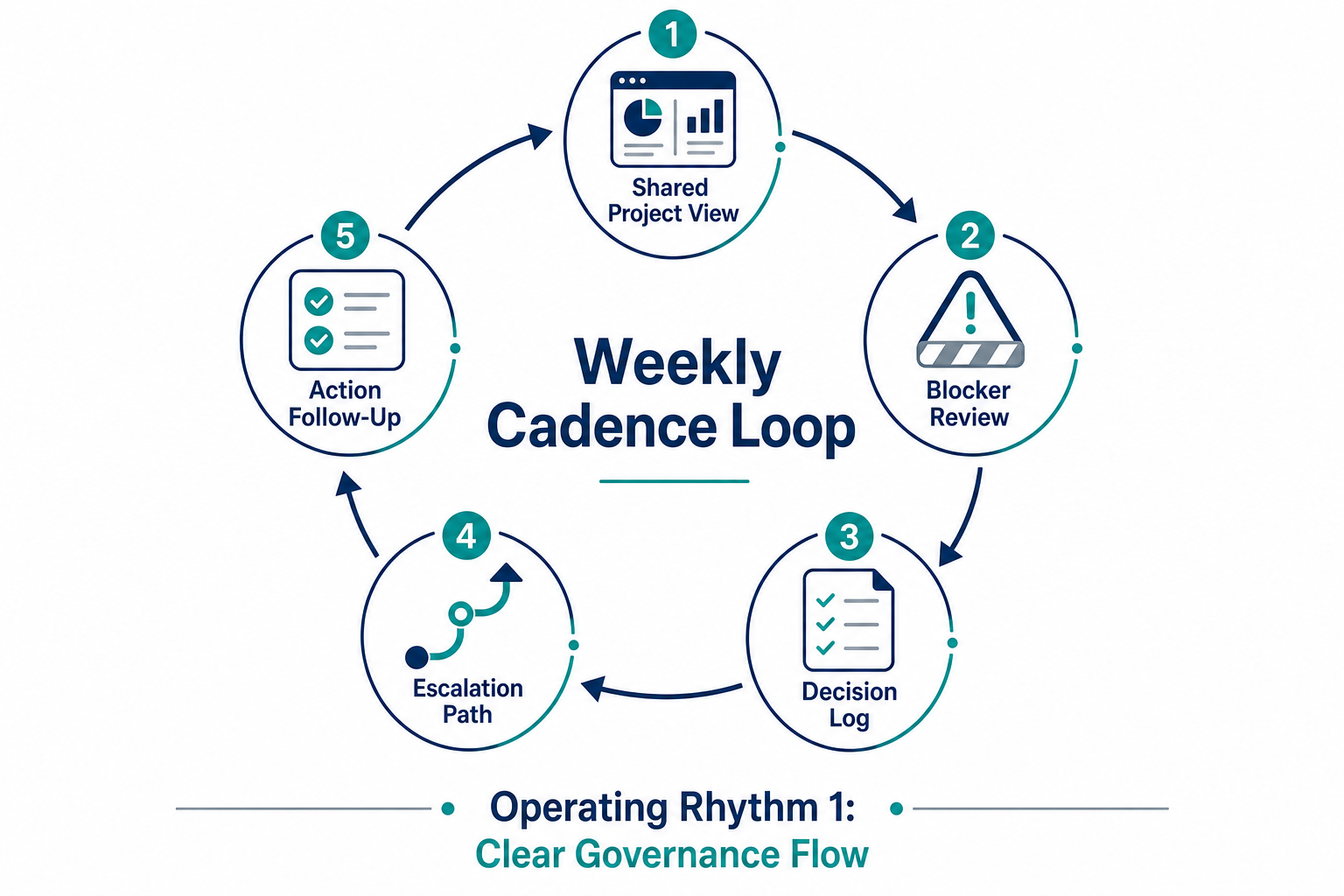
A good first rhythm usually has four pieces.
1. One shared project view
Everyone should know where to find the current view of active work. This is not a reporting pack. It is a working view, updated because people use it to make decisions.
2. One weekly cadence
Create one recurring conversation where leaders and delivery owners review the work that needs attention.
Keep it focused:
If the meeting becomes a readout of everything people already wrote down, stop and redesign it.
3. One decision log
Many organizations do not have a project problem. They have an unresolved-decision problem.
A simple decision log should capture:
This creates accountability without creating drama. The point is not to shame people. The point is to stop important work from waiting in silence.
4. One escalation path
Teams need to know what happens when something is blocked.
The escalation path should answer:
Without this, the PMO becomes a place where problems are recorded but not removed.
The third month is where many PMOs get impatient.
They have a project view. They have a cadence. They have a few logs. Now they want to standardize everything.
Slow down.
Before scaling, ask whether the first routines are actually working.
Look for evidence:
If those signals are not present, adding more templates will not help.
Stabilize the basics first.
This is also the moment to remove anything that is not creating value. If a field in the project view is never used, delete it. If a meeting segment produces no decisions, cut it. If a risk log is just archival, redesign it around action.
A lightweight PMO should be willing to remove its own bureaucracy.
I have seen this pattern work best when the PMO begins as a service to the operating rhythm, not as a control function.
In practice, that means the first 90 days should feel modest.
No new enterprise tool. No 40-page methodology. No promise that every project will now be perfectly governed.
Instead:
That is enough to start.
The first wins are usually practical. A duplicated initiative gets spotted. A decision that has been floating for three weeks gets an owner. Two teams discover a dependency before it becomes a missed deadline. A leader sees, for the first time, how many projects depend on the same scarce expert.
None of that looks glamorous.
It is still exactly where the PMO starts to earn trust.

Use this 90-day starter template as your first PMO operating plan.
Copy it into a shared document and fill it in with your leadership team.
1. The operating pain we will improve
2. Active work view
3. Weekly cadence
4. Decision log
5. Escalation path
6. 90-day success criteria
The first 90 days are not about proving that the organization needs more governance.
They are about proving that the right amount of governance can make delivery easier.
Start there.
Project Management Institute (2024). "Pulse of the Profession 2024: The Future of Project Work."
Project Management Institute (2023). "Pulse of the Profession 2023: Power Skills, Redefining Project Success."
Harvard Business Review (2021). "Why Good Projects Fail Anyway."
McKinsey & Company (2020). "How to improve the odds of delivering IT projects on time and on budget."
Stay up to date with our informative blog posts.
Struggling with complex projects, IT leadership challenges, or strategic execution? With over 30 years of experience in delivering high-impact results—whether rescuing delayed initiatives, optimizing resources, or driving transformation—I provide the clarity, structure, and leadership needed for success.
Let’s discuss how I can help you achieve your goals. Schedule a call today!


